After the Midterms, Americans Find Common Ground for the Role of Business in Society and AI, New Research from Carol Cone ON PURPOSE Finds
PR Newswire
NEW YORK, Nov. 19, 2026
Seven in 10 Americans want companies to maintain or expand their role in addressing social issues, according to the third annual Corporate Social Action Tracker. More than eight in 10 support action on communities, employees, and national challenges, and 80% say it's important companies share some of AI's economic gains with workers.
NEW YORK, Nov. 19, 2026 /PRNewswire-PRWeb/ -- Days after a midterm election that reshaped Washington and the country, Americans from all parties agree on what they expect from corporate America.
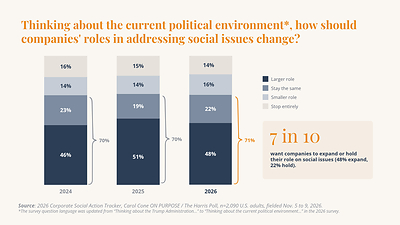
New research conducted immediately following the November elections reveals that seven in 10 Americans (71%) want companies to maintain or expand their role in addressing social issues, sending a powerful message to corporate leaders amid today's polarized political environment. Nearly half (48%) believe companies should play a larger role, while another 22% want them to sustain their current level of engagement.
The findings come from the 2026 Corporate Social Action Tracker, the third annual study conducted by The Harris Poll for Carol Cone ON PURPOSE (CCOP), surveying 2,090 U.S. adults.
At a time when corporate leaders weigh political change, economic uncertainty, and pressure to reconsider their social commitments, the research offers direction: Americans want companies to stay engaged and deliver results.
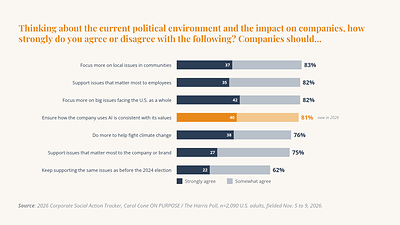
More than eight in 10 Americans (83%) agree companies should focus more on local community issues, 82% want companies to support issues important to employees, and 82% believe companies should focus more on major national challenges, including healthcare and jobs.
Now in its third year, the Corporate Social Action Tracker reveals that Americans' expectations of business remain strong despite shifting political pressures*.
"While Americans voted differently, they find common ground in their expectations of business," said Carol Cone, CEO of Carol Cone ON PURPOSE and a pioneer of corporate purpose. "For three years, we've tracked public sentiment through extraordinary political and social change. The message is clear: Americans want companies to address real needs, strengthen communities, and create opportunity. Corporate purpose is a business strategy that can unite people around progress, not a political position."
Across Party Lines, America Agrees: Companies Have a Responsibility to Society
Perhaps the most surprising finding is the broad agreement across political parties about the role of business in society. Americans agree that companies should:
- 83% focus more on local issues, including affordable housing and schools.
- 82% support issues that matter most to employees.
- 82% focus more on major challenges facing the country, such as healthcare and jobs.
- 81% ensure their use of artificial intelligence is consistent with their stated values.
- 76% do more to fight climate change, a statistically significant increase from 73% in 2025.*
- 75% support issues that matter most to their company or brand.
Majorities of every party agree on all six, including climate change, where the gap is widest (Republicans 64%, Independents 78%, Democrats 89%). These figures combine respondents who strongly agree and somewhat agree.
Even on climate change, where political differences are greatest, nearly two-thirds of Republicans support greater corporate action.
"These findings reveal something important that unites us," said Wendy Salomon, Head of Reputation at The Harris Poll. "Americans across the political spectrum believe companies can and should be part of the solution to society's challenges. That's a powerful mandate for business leadership."
Americans Want Companies to Address Issues Closest to Them
While inflation, healthcare, and immigration dominate political debate, Americans identify a broad range of personal priorities where they see opportunities for companies to make a difference.
Aside from inflation and immigration, health and wellbeing is overwhelmingly the most important broad issue, selected by 75% of Americans, followed by family and social support (50%), and education and digital literacy (48%).
Among specific issues, mental health support leads at 35%, followed by senior care (30%), hunger relief and nutrition (26%), and military and veteran support (26%). AI's impact on society, new to the list this year, was chosen by 24%.
Mental health support is a leading concern among Gen X (ages 46-61) at 40%, and Millennials (ages 30-45) at 37%, while senior care is particularly important to Baby Boomers (ages 62-80) at 53%.
The importance of equity and rights declined from 33% in 2025 to 29% in 2026, while health, family, education, environment, and workforce priorities remained statistically stable. It is also where the parties differ most on personal priorities, named by 43% of Democrats and 17% of Republicans.
"Americans want companies to focus on issues that affect their daily lives," Cone said. "From mental health and education to housing and economic opportunity, businesses have tremendous capabilities to make a difference. The opportunity is to connect those capabilities to real human needs and demonstrate measurable results."
Gen Z Continues to Push Corporate America to Do More
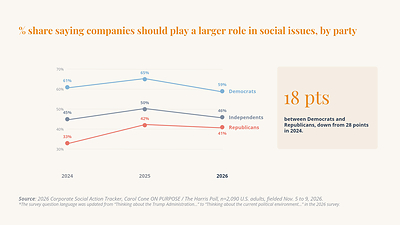
Sixty-one percent (61%) of Gen Z adults (ages 18-29) want companies to play a larger role in addressing social issues, compared with 48% of Americans overall. Democrats are also especially supportive of a larger corporate role (59%), compared with 46% of Independents and 41% of Republicans.
For Gen Z, mental health support (32%) and protecting women's rights (29%) remain the leading specific issues, consistent with 2025.*
These findings suggest that even as corporate leaders reassess their public positions on social issues, the next generation of employees and consumers still expect companies to contribute to society.
AI Creates a New Corporate Responsibility: Share the Benefits, Not Just the Profits
The 2026 Corporate Social Action Tracker added a new section on AI to understand Americans' expectations for how companies distribute its benefits. Americans expect AI's economic and social benefits to extend beyond corporate profitability.
Americans consider it important that companies:
- 80% share the economic gains from AI with employees.
- 80% pass the benefits of AI along to customers.
- 78% use AI to benefit communities and society.
- 76% use AI to support environmental sustainability.
- 76% develop AI skills for the future workforce.
These figures combine respondents who consider each action very important or somewhat important. Agreement crosses party lines: At least 73% of Republicans, Democrats, and Independents rate each of the five as important.
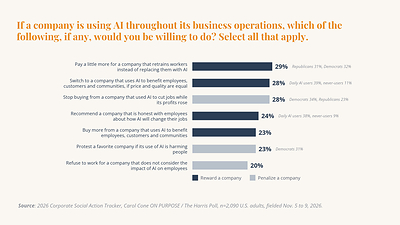
AI use is mainstream: 77% of Americans have used AI tools, 61% use them weekly or more, and 33% use them daily. Consumers also indicate that corporate AI practices could influence their behavior. Seven in ten Americans (71%) say a company's approach to AI would lead them to take at least one of seven actions, from paying more to switching brands. No single action draws more than 29%.
- 29% would pay a little more to buy from a company that retrains workers affected by AI for new roles instead of replacing them with AI.
- 28% would switch to a company using AI to benefit its employees, customers, and communities, if price and quality are equal (39% of daily AI users vs. 11% of those who have never used AI).
- 28% would stop buying from a company that used AI to cut jobs while its profits rose.
Adults with children in the household are more willing than those without to act, including to switch (32% vs. 25%), recommend (30% vs. 21%), buy more (29% vs. 20%), or protest (28% vs. 21%). They are also heavier AI users: 46% use AI daily, compared with 26% of adults without children in the household.
"The Americans who use AI every day are the ones asking the most of the companies deploying it," said Kristian Merenda, Chief Operating and Innovation Officer at Carol Cone ON PURPOSE. "They are three times as likely as people who have never used AI to switch to a company that uses it to benefit employees, customers, and communities. Familiarity is raising expectations, and a company's most AI-fluent customers will be its most demanding."
Three Years of Research Reveal an Enduring Expectation: Business Must Be Part of the Solution
The Corporate Social Action Tracker provides a perspective on how Americans' expectations of companies have evolved through significant political and economic change. Despite shifting political rhetoric and growing scrutiny of corporate social commitments, the public's desire for business engagement has held steady.*
Meanwhile, majorities continue to agree that companies should focus on communities, employees, and key national challenges such as healthcare and jobs. The findings suggest that the debate over corporate purpose is not whether companies should engage in society, but how they do it authentically, effectively, and in ways that create value for stakeholders and the business.
Five Priorities for Corporate Leaders in 2027: From Quiet Commitment to Confident Action
As companies respond to political change, many have continued their social impact investments while adjusting their language and reducing public communications. The new research offers five priorities for moving forward:
- Stay the course on purpose. With 71% of Americans wanting companies to maintain or expand their social role, political uncertainty should not negate strategic, long-term commitments. Protect programs that deliver measurable value for society and the business.
- Unite around shared human needs. Focus on healthcare, education, workforce opportunity, and stronger communities—issues that resonate across political lines. Lead with tangible outcomes rather than polarizing terminology.
- Move from corporate silence to strategic visibility. Communicate impact with greater confidence, using credible data, employee voices, and community partners. Be selective about public advocacy, but don't let political caution make good work invisible.
- Be principled, not politically reactive. A shifting political climate does not eliminate the risk of corporate criticism or retaliation. Ground commitments in company values, business priorities, and stakeholder needs, with disciplined legal and reputational risk management.
- Make AI a new engine of shared prosperity. With 80% of Americans saying it's important that companies share AI's benefits with employees and customers, connect AI investments to workforce development, customer value, and positive community outcomes.
"Americans are not asking companies to abandon their social commitments," said Cone. "They are calling for action that is relevant, consistent with company values, and capable of producing meaningful outcomes. Whatever their politics, Americans share needs and aspirations, and companies have a unique opportunity to bring people together around them. The future of purpose will be defined by what companies make possible for people, more than by what they say they stand for."
Methodology
This survey was conducted online within the United States by The Harris Poll on behalf of Carol Cone ON PURPOSE from November 5-9, 2026, among 2,090 adults ages 18 and older. The sampling precision of Harris online polls is measured by using a Bayesian credible interval. For this study, the sample data is accurate to within +/- 2.7 percentage points using a 95% confidence level. Prior waves were conducted November 6-10, 2025, among 2,087 U.S. adults and November 14-18, 2024, among 2,092 U.S. adults (each +/- 2.5 percentage points). The credible interval will be wider among subsets of the surveyed population of interest. For complete survey methodology, including weighting variables and subgroup sample sizes, please contact hello@purposecollaborative.com.
*The survey question language was updated from "Thinking about the Trump Administration…" to "Thinking about the current political environment…" in the 2026 survey.
About Carol Cone ON PURPOSE
Carol Cone ON PURPOSE (CCOP) is the pioneering social impact and sustainability communications agency that helped create the modern purpose field. For more than four decades, the team at CCOP has helped companies, brands, nonprofits, and foundations discover, activate, and measure purpose through social impact strategy, sustainability communications, employee engagement, strategic partnerships, thought leadership, and creative content development. CCOP continues to lead and advance the field through groundbreaking research, books, Harvard Business School case studies, the award-winning Purpose 360 podcast, and the Purpose Collaborative, a network of more than 40 specialized firms and subject matter experts that provides clients with deep expertise and geographic reach Learn more at CarolConeONPURPOSE.com.
About The Harris Poll
The Harris Poll is one of the longest running surveys in the U.S. tracking public opinion, motivations and social sentiment since 1963 that is now part of Harris Insights & Analytics, a global consulting and market research firm that delivers social intelligence for transformational times. We work with clients in three primary areas; building twenty-first-century corporate reputation, crafting brand strategy and performance tracking, and earning organic media through public relations research. Our mission is to provide insights and advisory to help leaders make the best decisions possible.
Media Contact
Kristin Kenney, Carol Cone ON PURPOSE, 1 6178404789, kkenney@purposecollaborative.com, https://www.carolconeonpurpose.com/
 View original content to download multimedia:https://www.prweb.com/releases/after-the-midterms-americans-find-common-ground-for-the-role-of-business-in-society-and-ai-new-research-from-carol-cone-on-purpose-finds-302945900.html
SOURCE Carol Cone ON PURPOSE


